
Grevenmacher
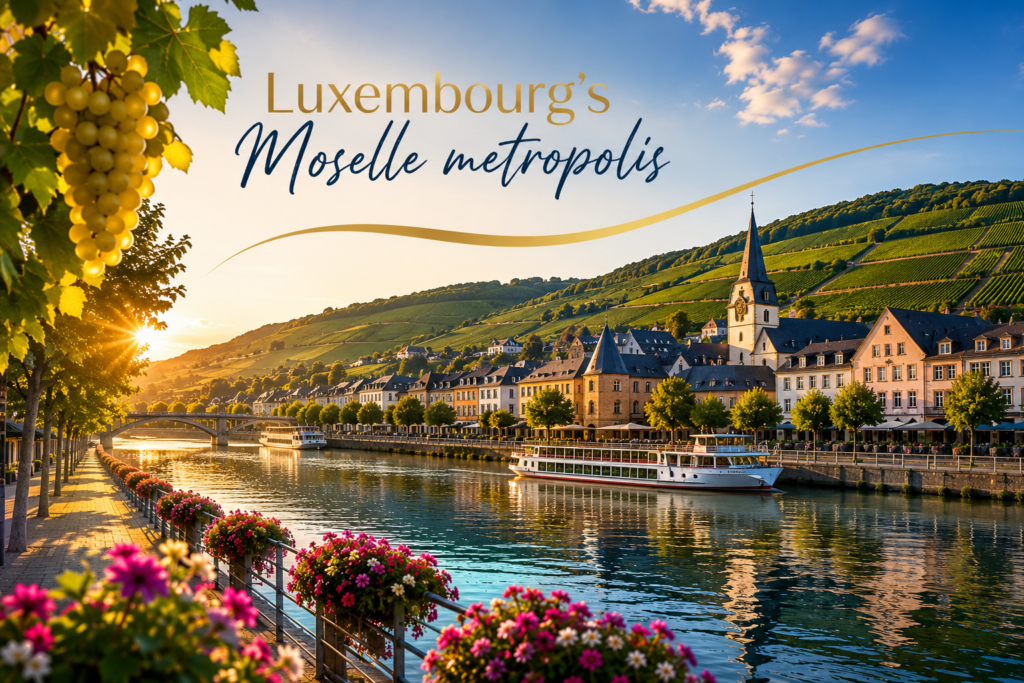
Discover Grevenmacher — Luxembourg’s Moselle metropolis
Introduction
Discover Grevenmacher — Luxembourg’s Moselle metropolis, where centuries of history meet vineyards, wine culture and life beside the river.
Known locally as Gréiwemaacher or simply Maacher, this historic town sits between the Moselle and vineyard-covered slopes in the heart of Luxembourg’s wine region. Behind its lively riverfront lies a former fortified town whose story can still be traced through old lanes, defensive remains and historic landmarks.
From wine and Crémant tastings to the Butterfly Garden, cultural discoveries and walks beside the Moselle, Grevenmacher captures the distinctive Miseler way of life — welcoming, connected to the land and never far from a good glass of Luxembourg wine.
At a Glance
- Canton
- Grevenmacher
- Known for
- Luxembourg wine and Crémant • Moselle River • Vineyards • Grape and Wine Festival • Luxembourg Wine Queen • Butterfly Garden • Kulturhuef • Historic fortified town
- Best suited for
- Best suited for: Wine lovers • History enthusiasts • Families • Couples • Walkers • Cyclists • Culture lovers • Relaxed day trips
- Official website
- Visit official website
Grevenmacher Through the Centuries: From Fortress Town to Moselle Metropolis
Grevenmacher’s story reaches back well before the Middle Ages. Archaeological and historical evidence points to settlement in the Moselle valley before Roman times, while an early settlement developed near the later Roman road connecting Trier and Luxembourg.
The location became strategically important to the Counts of Luxembourg. In 1252, Count Henry V — Henry the Blond — granted Grevenmacher its Charter of Franchise, an important milestone in the development of the town.
During the 13th and 14th centuries, Grevenmacher developed into a fortified settlement. Its defensive wall formed a roughly rectangular enclosure protected by numerous towers and four gates. At its centre stood the old watch and defence tower that would later become part of the parish church.
In 1357, Duke Wenceslas I granted Grevenmacher market rights and authorised the use of a town seal, strengthening its role as a regional commercial centre.
The fortifications did not survive intact. In 1688, on the orders of Louis XIV, Grevenmacher’s defensive wall was dismantled under General Boufflers. Nevertheless, sections of the former fortifications and their traces remain part of the historic townscape.
Another defining event occurred in 1822, when a devastating fire destroyed 147 houses, around 80 stables and 39 barns.
Grevenmacher became the administrative centre of its canton and district in 1839. The town continued to develop as transport links improved: the first permanent cross-border bridge towards Wellen was constructed in 1880–81, and a railway connection between Wasserbillig and Grevenmacher opened in 1891.
The 20th century strengthened Grevenmacher’s association with modern viticulture. The Second World War caused considerable damage, including the destruction of the Moselle bridge.
A major transformation followed in 1964, when canalisation of the Moselle and the Grevenmacher-Wellen barrage and lock helped turn the river into an international navigation route.
Today, Grevenmacher brings together these layers of history — Roman-era connections, medieval fortifications, commerce, cross-border exchange and generations of wine-growing tradition — within a modern town that remains deeply connected to the Moselle.
Places to Discover
🦋 Päiperleksgaart – Butterfly Garden
🏛️ Kulturhuef
⛪ Parish Church of St Laurent
🧱 Turgaass & Fortress Remains
💧 The Kundel
⛪ Chapel of the Holy Cross
🍇 Caves de Grevenmacher – Domaines Vinsmoselle
🍾 Caves Bernard-Massard
Things to Do
🍷 Taste Luxembourg Wine & Crémant
🚢 Experience the Moselle from the Water
🚶 Follow the Historical & Cultural Walk
🖨️ Try Your Hand at Printing
🍽️ Enjoy the Miseler Way of Life
Nature and Outdoors
🌊 The Moselle
🍇 Vineyard Slopes
🌳 Moselle Promenade
🥾 Comfort Hiking Route
🚲 Cycling Landscape
🌿 Kreuzberg
Culture and Local Identity
🍇 A Wine Town |Vineyards have become inseparable from Grevenmacher’s modern identity. Wine estates, cellars, wine events and the surrounding slopes all reinforce the town’s role within Luxembourg’s principal wine-growing region.
👑 Home of the Luxembourg Wine Queen Tradition |Grevenmacher plays a particularly visible role in Luxembourg’s wine culture through the annual Grape and Wine Festival, during which the Luxembourg Wine Queen is traditionally crowned.
🎉 Drauwen- a Wäifest | The Grevenmacher Grape and Wine Festival is one of the town’s defining traditions. Held annually in September, it brings concerts, festivities, a folkloric procession, wine celebrations and the Wine Queen tradition into the streets of Maacher.
🍷 Wäimoart | Grevenmacher’s wine market is another longstanding expression of the relationship between the town, its winegrowers and the wider Moselle region.
🖨️ Printing & Playing Cards | Grevenmacher has an unusual industrial-cultural legacy through the Dieudonné family, whose playing-card manufacturing history is preserved today at Kulturhuef.
🏘️ Maacher | The Luxembourgish name Gréiwemaacher, often shortened locally to Maacher, is part of the town’s everyday identity and appears throughout local cultural life.
Visitor Information
- Public transport
- 🚌 From Luxembourg City — Grevenmacher does not currently have a passenger railway station. One useful direct connection is RGTR Line 311, linking Luxembourg-Kirchberg (Gare Luxexpo) with Grevenmacher and continuing towards Machtum. 🚆🚌 Via Wasserbillig — Another practical option is to travel by train towards Wasserbillig and continue to Grevenmacher using the regional bus network. 🚌 Grevenmacher Bus Station — Grevenmacher, Gare routière is the town’s principal public-transport interchange and is within walking distance of the centre and Moselle promenade.
- Parking
- 🚗 Public parking is available at several locations around Grevenmacher. For visitors exploring the riverfront, the Route du Vin parking area is particularly useful. Official accessibility information for the Grevenmacher comfort route identifies this as paid public parking and records eight designated disabled parking spaces.
- Accessibility
- Accessibility at individual historic buildings, wineries and other attractions can vary, so confirm directly with the venue when specific access arrangements are required.
- Current information
- Check the official source